

Audit log
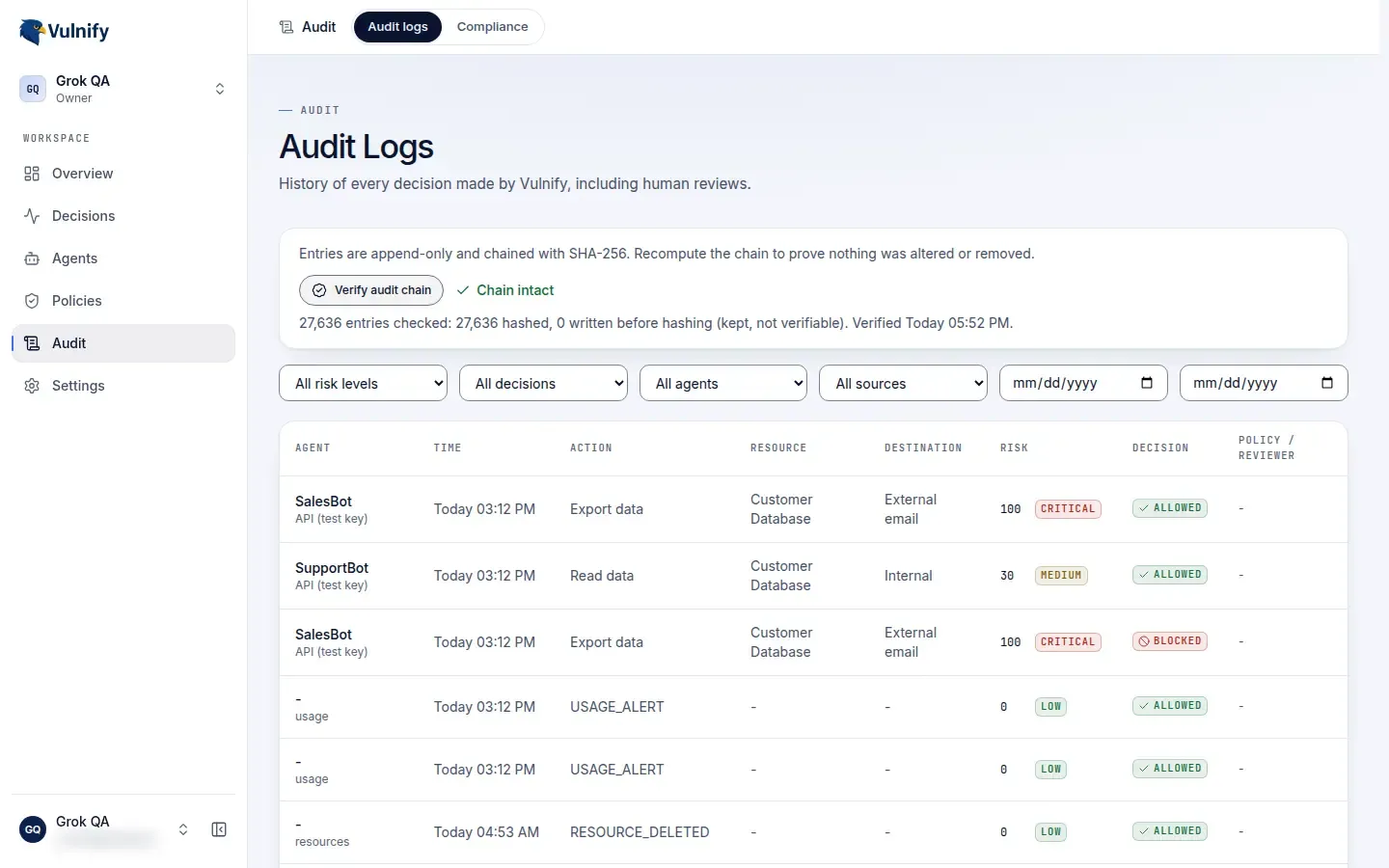
Every decision Vulnify makes is written to the audit log, including human reviews. The log is the record of what was allowed, sent to review, or blocked, and why.
The app’s audit log is the history of those decisions. Sources shown there include the API (including test keys), the gateway, and human review. Sandbox events from TEST keys are kept out of the main dashboards. The compliance export of recent security events also excludes sandbox runs.
Hash chain
Section titled “Hash chain”Each decision is appended to a per-organization SHA-256 hash chain. Verification recomputes the chain and reports the first entry that does not match. In the app, open the audit log and run Verify audit chain. The compliance report shows the same check: either the chain verified, or verification failed.
The chain is how Vulnify makes the trail tamper-evident. A successful verification means the stored entries still hash together. It is not a certification of your organization, and it is not a claim that the underlying systems are impossible to compromise.
The public OpenAPI document does not include an audit-log download. With an API key you can read one decision at a time with GET /v1/events/{id}. Vulnify can also POST decision, anomaly, and test deliveries to an endpoint you register. See Webhook deliveries.
In the app, an owner or an admin downloads recent security events from Compliance with Export evidence. The route is GET /compliance/export. It uses the app session, not an API key, so it is not part of the public machine contract. Omitting format returns JSON. CSV is GET /compliance/export?format=csv. The file leaves out sandbox runs.
The JSON download includes a SHA-256 checksum of its canonical JSON. That checksum is in the file’s digest field, and the response header x-vulnify-evidence-sha256 repeats it. digest.canonicalization documents how the bytes are produced, so the checksum is not a sha256sum of the downloaded file. The CSV holds the same data as one table per section. Its file checksum is a plain SHA-256 of those bytes (x-vulnify-file-sha256). The CSV also carries the canonical-JSON checksum it was built from. Store the checksum apart from the file, for example on the audit ticket.
Settings → Webhooks has a separate SIEM export for owners and admins. It downloads recent security events as JSON or as CEF lines: GET /export/siem?format=json or GET /export/siem?format=cef, with limit of 100, 500, or 1000. CEF is text/plain, one event per line. That download is not the compliance evidence bundle.
Account and organization downloads from Settings do not include these events. See Your data (export and deletion).
What a record contains
Section titled “What a record contains”Records hold action metadata: agent, action, resource, destination, record counts, timestamps, risk results, review decisions, and notes. They are not a copy of the customer records the agent read or exported. Optional content sent for scanning is not stored. Findings may be stored as types and LGPD categories. See Risk engine.
Retention
Section titled “Retention”Decision events are deleted automatically after your plan’s retention window (Developer 30 days, Team 30 days, Business 365 days). The deletion job runs regularly. Enterprise retention follows your contract; there is no automatic deletion unless agreed. When an event is deleted, its audit-log entry (the decision, risk score and related metadata) is kept for as long as the organization exists, because the audit log is append-only. Deleted data can remain in encrypted backups for up to 30 days. GET /public/plans publishes those windows as retentionDays. See Plans.
After the account ends, customer data is deleted except what the law requires Vulnify to keep. Details are in the privacy policy.